2746 Via Orange Way Spring Valley, CA, USA
+1 (619) 670-9590

Author: Vitali Charapovich

Euramco Group officially launches NOMAD firefighting pump brand

Press release

Euramco Group officially launches NOMAD firefighting pump brand

More than half a century after Euramco began in pump and turbine engineering, NOMAD brings the Group’s accumulated experience in fluid dynamics, emergency-response equipment, electrification, power systems and connected controls back to water.

Euramco Group today announced the official global launch of NOMAD, its dedicated firefighting pump brand and long-term platform for the development of portable, vehicle-mounted, electrified and connected water-movement systems.

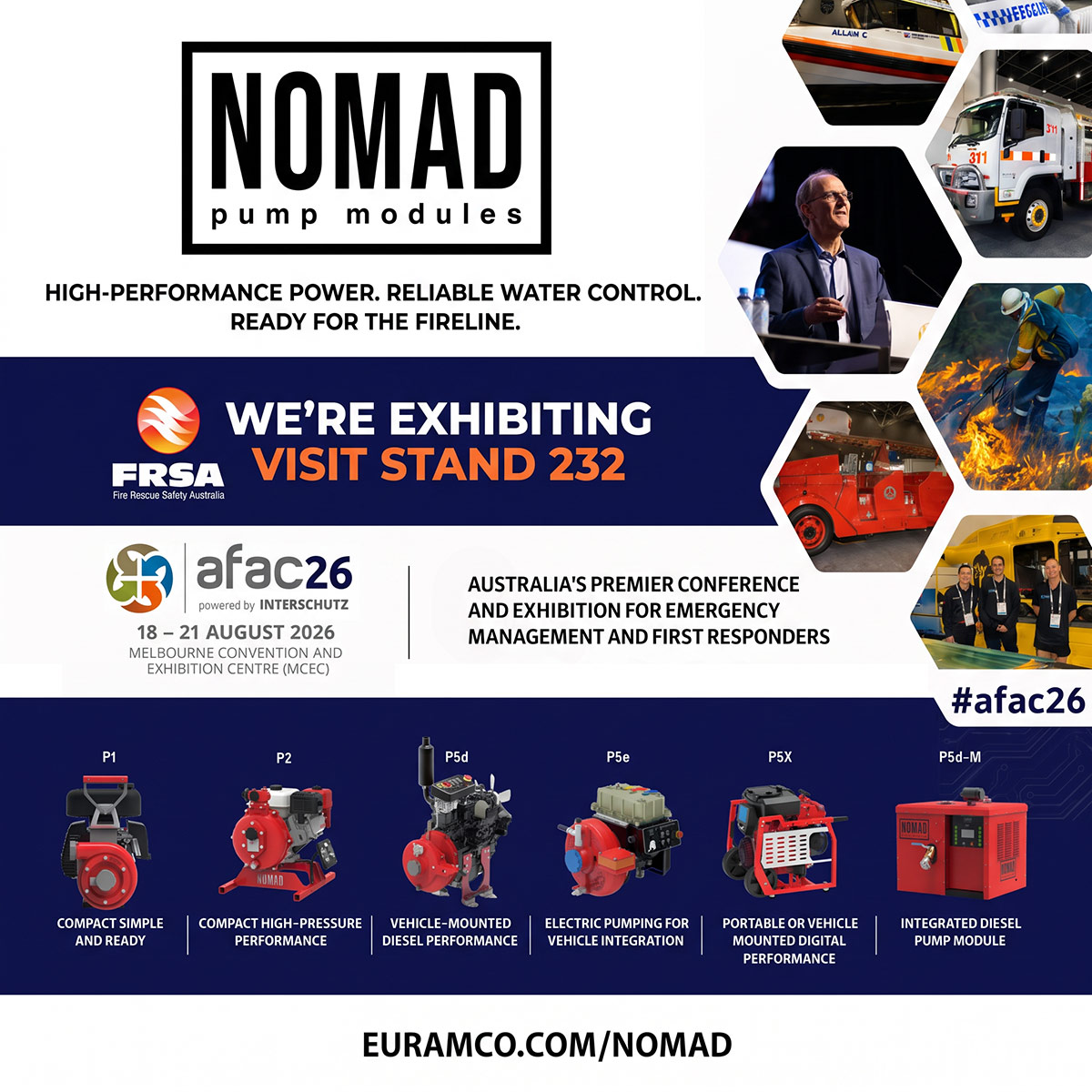
The formal introduction will take place at AFAC26 powered by INTERSCHUTZ in Melbourne, Australia, August 18–21, 2026, where NOMAD will introduce three new pump platforms — the NOMAD P1, P5d and P5e — and mark the beginning of the brand’s next stage of international expansion.

The launch represents both a new chapter for Euramco and a return to where much of the company’s engineering history began.

NOMAD pump modules at AFAC26: high-performance power, reliable water control, ready for the fireline. Fire Rescue Safety Australia, stand 232, Melbourne Convention and Exhibition Centre, 18–21 August 2026.

From pumps, to airflow, and back to pumps

Euramco’s relationship with pumps predates the brands for which the company is best known today.

The company’s engineering roots extend to the 1960s and 1970s, when the business developed expertise in centrifugal pumps, turbines and rotating machinery through repair and manufacturing work for U.S. Navy shipboard applications. That early experience established a practical engineering culture centered on moving fluids reliably under demanding operating conditions.

During the 1980s, Euramco applied its knowledge of pumps, turbines and fluid dynamics to a different firefighting problem: moving air. The result included the development of a water-turbine-powered axial desmoking fan for U.S. Navy shipboard damage control.

That work became part of the foundation for RAMFAN, through which Euramco expanded into structural firefighting ventilation and later hazardous-area air movement.

Over the following decades, the company increasingly moved beyond traditional mechanical systems. Euramco developed variable-speed DC drives, purpose-built brushless motors, motor controllers, chargers and rugged lithium battery systems designed specifically for emergency-response duty.

In 2016, that development path resulted in the RAMFAN 40V Brushless PPV platform and an increasingly integrated approach to product engineering in which the motor, controller, power source, mechanical system and user interface were designed as one system rather than assembled from unrelated components.

That same philosophy later expanded into PRO//connect, encompassing wireless diagnostics, remote control, CAN-based control architecture, IoT connectivity and fleet visibility, and into Kraken Power, Euramco Group’s platform for onboard electrical power, battery systems and power electronics for fire apparatus and specialty vehicles.

Now, NOMAD brings those capabilities back to water.

“There is a certain symmetry to the NOMAD story. Our engineering history began with pumps and rotating machinery. We then spent decades learning how to move air, build high-efficiency electric machines, manage batteries and power electronics, design controls, and connect equipment in the field. NOMAD brings that accumulated capability back to one of the most fundamental jobs in firefighting: reliably moving water.”

Zach Allen, Director of Euramco Group

A modern pump business built in Asia

NOMAD also builds on Euramco’s more recent firefighting pump experience.

Since approximately 2010, Euramco has established itself as a key supplier of firefighting vehicle pumps into the rapidly developing Chinese and ASEAN fire apparatus markets, working with vehicle manufacturers, distributors and fire-service customers across the region.

That experience provided the company with a renewed understanding of pump specification, vehicle integration, serviceability and the operational differences between markets.

Rather than immediately creating a global pump brand, Euramco developed its approach regionally.

In 2020, the NOMAD identity was introduced in ASEAN as a focused platform for firefighting pump applications. The brand continued to develop through real market requirements, product development and regional customer experience.

In 2024, Euramco introduced NOMAD into Australia, initially focusing on the particular requirements of bushfire and rural firefighting — long-duration operations, difficult access, remote water sources, high ambient temperatures, vehicle integration and the need for equipment that can be maintained and supported locally.

AFAC26 represents the next step: the transition of NOMAD from a regionally developed pump program into a clearly defined Euramco Group global firefighting pump brand.

Pumps for a changing fire geography

NOMAD is being developed around a simple operating philosophy:

Fire follows climate, not borders. We design pumps for the geography it is moving into.

Wildland and forestry firefighting requirements vary significantly by terrain, water availability, vehicle architecture, climate and operating doctrine. NOMAD therefore approaches pump development as a platform rather than as a collection of unrelated products.

The objective is not to add technology simply because it is available.

NOMAD begins with proven mechanical pumping principles and introduces modern power systems, controls, diagnostics, connectivity and electrification where those technologies produce measurable operational value — including improved efficiency, reduced noise, easier maintenance, better fleet visibility, simpler vehicle integration or improved equipment readiness.

The long-term platform is intended to span traditional engine-driven portable pumps, electric pumping systems, vehicle-mounted pumps, connected diagnostics and future integrated water-movement architectures.

Three new NOMAD platforms at AFAC26

At AFAC26, Euramco will introduce three additions representing different points within that strategy:

NOMAD P1

A compact portable fire pump designed around simplicity, mobility and dependable field operation.

NOMAD P5d

A diesel-driven P5-class firefighting pump platform developed for sustained wildland, forestry and vehicle-mounted pumping applications.

NOMAD P5e

An electric firefighting pump platform that applies Euramco Group capabilities in brushless motor technology, liquid-cooled power electronics, battery systems and intelligent control to fixed-mounted pumping applications.

Together, the three products demonstrate the NOMAD development philosophy: begin with the operational requirement, select the appropriate hydraulic platform and power source, and apply technology only where it improves the mission.

Additional NOMAD pump configurations and water-movement systems will follow as the platform expands.

Australia first, global direction

While AFAC26 marks the formal beginning of NOMAD’s global expansion, Australia and New Zealand remain the brand’s immediate commercial focus through the end of 2026.

In Australia, NOMAD is supported through Fire Rescue Safety Australia (FRSA), providing the local sales, training and support infrastructure required to establish the brand with fire services, rural fire organizations, and other users.

Additional international market development will follow in a disciplined sequence as product configurations, certifications, distribution and service structures are established.

For Euramco, the objective is not simply to enter another equipment category.

It is to build a firefighting pump platform capable of evolving over decades.

“NOMAD is not an exercise in putting a new name on a conventional pump. We intend to approach pumps the same way Euramco approached ventilation, motors, battery systems and controls: understand the physics, understand the operating environment, build the complete system around the mission, and keep improving it.”

Zach Allen, Director of Euramco Group

AFAC26 therefore represents more than the launch of three products.

It marks the beginning of the next phase in a company history that started with pumps more than half a century ago — and has now come full circle.

Pumps for a changing fire geography.

About NOMAD

NOMAD, a Euramco Group brand, is a pump platform focused on portable and vehicle-mounted pumping systems and modular water solutions for wildland and forestry firefighting.

Born from Euramco’s roots in pump and turbine engineering, NOMAD combines proven mechanical design with the Group’s experience in high-efficiency motors, power electronics, lithium battery systems, rugged controls and connected diagnostics.

NOMAD is engineered around a mission-first principle: technology belongs in the system only when it improves performance, readiness, reliability, serviceability, safety or lifecycle value.

About Euramco Group

Euramco Group develops and manufactures mission-critical equipment and technology for fire, emergency response, defense, industrial and specialty-vehicle applications.

Its brands and technology platforms include RAMFAN portable ventilation systems, NOMAD firefighting pumps and water-movement systems, Kraken Power onboard electrical power systems, and PRO//connect controls, diagnostics and connected fleet technologies.

Euramco maintains engineering, manufacturing, sales and distribution capabilities serving customers and partners across North America, Europe and Asia-Pacific.

NOMAD at AFAC26

August 18–21, 2026 Melbourne Convention and Exhibition Centre Melbourne, Australia

Learn more

NOMAD – Born from Pumps. Built for What Comes Next.

Born from Pumps. Built for What Comes Next.

At AFAC 2026 in Melbourne, NOMAD makes its first public brand debut with three new firefighting pump platforms – and begins a new chapter in a story that started with pumps more than half a century ago.

Next week at AFAC 2026 in Melbourne, Fire Rescue Safety Australia will introduce three of our newest NOMAD pump platforms to the Australian and New Zealand fire market: the P1 lightweight portable pump, P5d diesel pump module, and P5e electric pump module.

For most people attending AFAC, this will be their first encounter with NOMAD.

It isn’t ours.

NOMAD has been developing quietly within Euramco Group for several years. We introduced the P5Xd pump-module concept in Australia in 2024 and have been developing products, testing ideas and learning from users across the Asia-Pacific region.

AFAC 2026 is different.

This is the first time we’re putting the NOMAD name, the product philosophy behind it, and our ambitions for the future in front of the broader fire industry.

So before talking about pumps, it’s probably worth explaining why NOMAD exists at all.

We started with pumps

Long before RAMFAN became known around the world for firefighting ventilation, Euramco’s engineering story began with water.

Our roots go back to RAM Centrifugal Products in San Diego in the 1960s, supporting U.S. Navy ships with the repair, reverse engineering and manufacture of pumps, steam turbines and other complex rotating machinery.

Much of that work existed because the original machinery was obsolete or its manufacturer could no longer support it. Keeping a naval vessel operational meant understanding how the machine actually worked – hydraulics, fluid dynamics, metallurgy, machining, bearings, seals, tolerances – and then engineering a reliable solution.

Failure wasn’t particularly interested in the age of the drawing or whether the original supplier still existed.

That engineering foundation eventually took us somewhere unexpected: from moving water to moving air.

In the 1980s, Euramco applied its rotating-machinery experience to a water-turbine-driven axial fan for U.S. Navy shipboard damage control. That path eventually grew into RAMFAN structural PPV, confined-space ventilation, hazardous-area ATEX and IECEx equipment, variable-speed DC drives and increasingly sophisticated purpose-built electric motors.

Then came batteries, motor controllers, chargers and power electronics.

Kraken Power grew from those capabilities into onboard and deployable energy storage and conversion systems.

PRO//connect added CAN-based controls, Bluetooth, remote diagnostics, IoT connectivity and fleet visibility.

And eventually we found ourselves looking back at where the whole journey had started.

Pumps.

NOMAD is not Euramco wandering into a fashionable new market.

It is Euramco returning to its roots.

But we’re not rebuilding yesterday’s pump company

The world those original pumps operated in has changed.

So has firefighting.

At NOMAD, we increasingly think about wildland and forestry fire as a geography problem.

The historical map of wildfire risk is becoming less useful as a predictor of the future.

Large-scale ocean-atmosphere phenomena such as ENSO and other recurring climate cycles influence temperature, rainfall, drought, snowpack, vegetation growth and subsequent fuel availability across enormous geographic areas. Their effects interact with longer-term changes in seasonal temperatures, land management, vegetation, water availability and expanding wildland-urban interfaces.

The important consequence for the fire service is not simply that historically fire-prone places may experience larger fires.

It is that serious wildland fire capability is becoming relevant in places where history gave communities little reason to build it.

Fire seasons change.

Their duration changes.

Vegetation changes more slowly.

Equipment fleets and procurement cycles change slower still.

We believe this changing geography will make wildland, forestry and rural firefighting one of the most rapidly evolving categories in the global fire industry over the coming decades.

NOMAD exists to help engineer for that new fire geography.

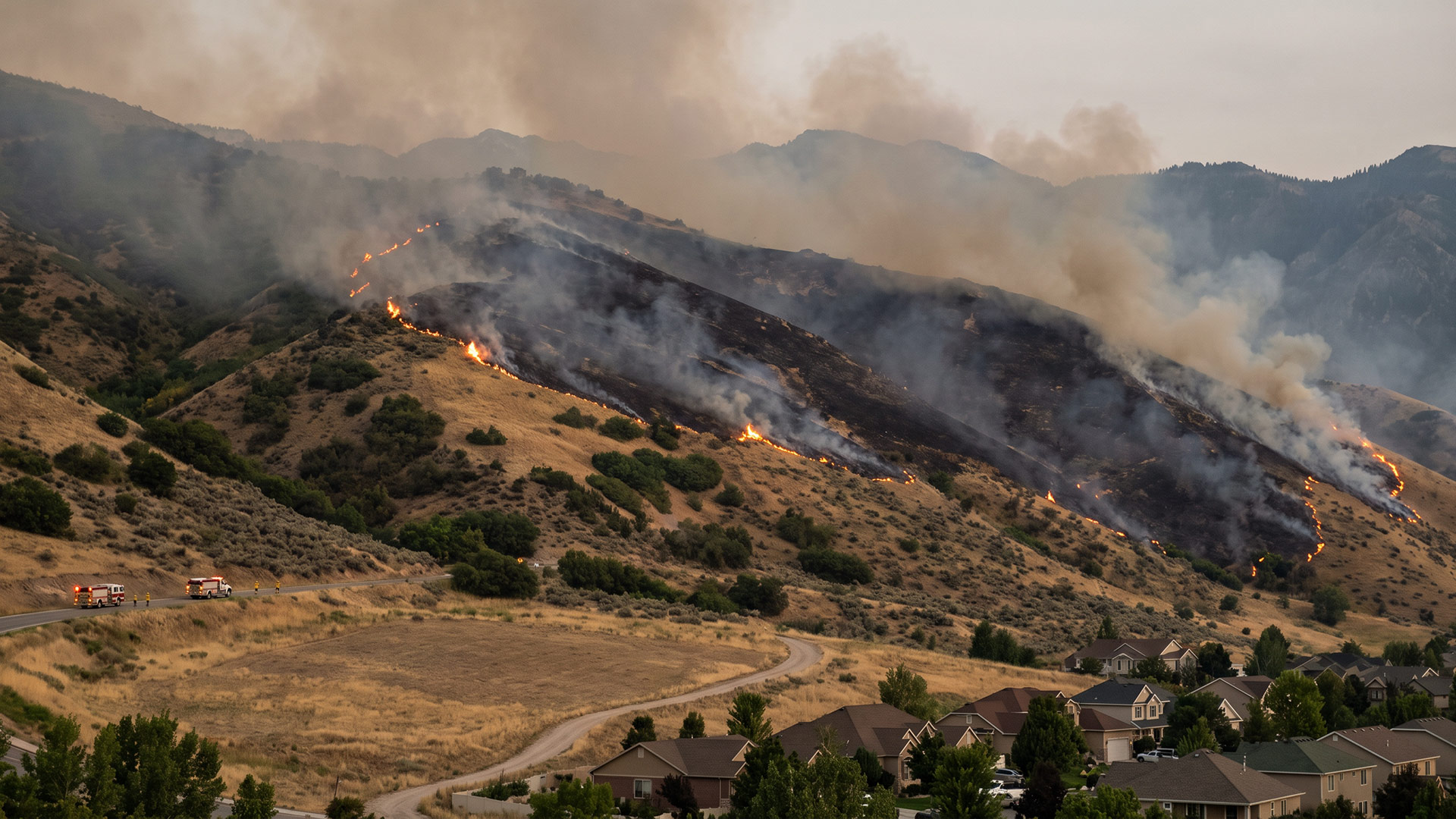
Smoke rising from the Willard Peak Fire in the foothills above North Ogden, Utah, in August 2025.
The Willard Peak Fire in the foothills above North Ogden, Utah, August 2025.

Follow the risk before the revenue

That belief will increasingly influence how we run the company.

We intend to look beyond yesterday’s pump sales and yesterday’s political market boundaries.

Over time, macro climate indicators, satellite observations, vegetation conditions, drought data, fire history and other geographic information should help influence where we develop dealer capability, where we position inventory, what products we prioritize and what applications our engineers should be solving next.

The question isn’t only:

Where are wildland pumps sold today?

It’s:

Where will firefighting water-movement capability be needed tomorrow?

That distinction matters.

A region with little historical demand may become strategically important before its procurement system recognizes the change. A product optimized around North American wildland practices may not be the right product for Australia, the Mediterranean, the Alps or emerging fire environments farther north in Europe.

Our ambition is to understand those differences – and build accordingly.

Pumps are the specialization

NOMAD isn’t intended to become an everything-for-forestry company.

There are already good companies doing that.

Our specialization is deliberate:

We engineer pumps, pump controls and firefighting water-movement systems.

From lightweight portable pumps to high-pressure systems, diesel modules, electric pumping and ultimately large-flow vehicle-mounted platforms, we intend to develop the category deeply rather than surround it with every possible adjacent SKU.

That philosophy should sound familiar to anyone who knows RAMFAN.

RAMFAN became successful by concentrating on moving air.

NOMAD intends to bring that same specialist mentality to moving water.

Petrol. Diesel. Electric. Whatever solves the problem best.

We also don’t believe the future of pumping is simply replacing every combustion engine with a battery.

Electric drive can provide remarkable advantages: instant torque, precise speed and pressure control, lower noise and vibration, reduced routine maintenance and entirely new possibilities for vehicle integration.

But those advantages matter only when the complete system works in the environment where firefighters actually operate.

Australian bushfire conditions can exceed 55°C ambient temperature, with direct sunlight, dust and sustained high-load operation. That’s why, for example, our 10 kW P5e architecture uses liquid cooling for its electric drive and energy system rather than assuming an electric motor is automatically the better solution simply because it is electric.

Where a Honda petrol engine is the right answer, we’ll use one.

Where Kubota or Yanmar diesel power makes sense, we’ll use it.

And where electric drive materially improves the mission, Euramco brings something relatively unusual to the pump industry: decades of internal experience developing motors, motor controllers, rugged lithium battery systems, power electronics and connected controls.

That capability gives NOMAD room to explore where firefighting pumping goes next rather than simply reproducing where it has already been.

Three new pumps in Melbourne

AFAC 2026 represents the next step.

The NOMAD P1 is our lightweight, straightforward portable platform for applications where simplicity, portability and field serviceability matter.

The NOMAD P5d moves into diesel-powered truck and skid applications for bushfire appliances, auxiliary pumping and larger mobile water systems.

And the NOMAD P5e begins to show another side of the roadmap: a 10 kW electric pump architecture intended for vehicle integration, combining hydraulic engineering with the electric-drive capabilities Euramco has accumulated elsewhere in the group.

These aren’t intended to represent the limits of NOMAD.

They’re the beginning.

Additional P-series platforms are already under development as we build toward a much broader family of firefighting pumps.

For now, however, the commercial debut of these products is deliberately focused on Australia and New Zealand, together with our long-standing regional partner, Fire Rescue Safety Australia.

There will be plenty more to say about the rest of the world later.

And about that logo…

If the NOMAD logo looks slightly different from the usual fire-equipment corporate identity, that’s intentional too.

I designed it with a little inspiration from the Parental Advisory stickers plastered across punk, alternative and hip-hop CDs when I was growing up in the 1990s.

Partly because I liked the graphic.

Partly because NOMAD should have a little attitude.

And partly as a small design-level protest against where a lot of industrial manufacturing has gone.

Euramco remains a family-owned manufacturing company, now in its third generation of leadership.

The fire industry, meanwhile, has experienced decades of consolidation. Many historic manufacturers and brands now sit inside increasingly large corporate and private-equity-owned groups.

There is nothing inherently wrong with scale or institutional ownership.

But we’re comfortable choosing another path.

We like engineers arguing about a casting.

We like people worrying about whether a seal will survive ten years from now.

We like having inventory available when a customer actually needs it.

We like developing products because we believe they should exist.

And we hope – although you never really know – that nobody around our table someday decides reducing production capacity and inventory would make the next quarterly report look a little nicer.

The logo is our small reminder of that.

Independent. Specialized. Slightly stubborn.

That’s probably a reasonable description of NOMAD too.

Back to water

More than half a century separates those early naval pumps in San Diego from the three NOMAD products arriving at AFAC in Melbourne.

Between them came naval damage-control equipment, RAMFAN, hazardous-area ventilation, brushless motors, batteries, power electronics, Kraken Power and PRO//connect.

That journey gave us capabilities the company that originally built pumps in the 1960s couldn’t possibly have imagined.

Now we’re bringing them back to water.

Not because the fire industry needs another pump brand.

Because we believe the geography of fire is changing, the technology available to firefighters is changing with it, and there is room for a specialist manufacturer willing to think about what firefighting water movement should look like for the next several decades.

Born from pumps. Built for what comes next.

See NOMAD at AFAC 2026

18–20 August 2026 Melbourne Convention and Exhibition Centre Fire Rescue Safety Australia – Stand 232

NOMAD Field Notes – Australia

August 2026 | NOMAD Field Notes – Australia

While Australia Watches Winter, the Northern Hemisphere Is Burning

What the 2026 Northern Hemisphere fire season–and a strengthening El Niño–might tell us about preparing for the Australian summer ahead.

Australia is still in winter.

Across much of the Northern Hemisphere, however, the 2026 fire season is providing a very different picture.

Large fires are burning across western North America. Oregon is experiencing an exceptionally severe fire season, while fires are active across Washington, Nevada, California, British Columbia and the broader western landscape. The United States has reached its highest national wildfire preparedness level as resources are committed across numerous incidents.

Across the Atlantic, prolonged heat and dry conditions have accompanied major fires in France, Spain and elsewhere in Europe. This follows a summer in which unusually high temperatures have extended across large parts of Europe, North America and Asia.

Australia is not merely watching this from a distance.

Australian and New Zealand firefighting personnel have travelled north to assist agencies in North America–another demonstration of the international cooperation that increasingly connects fire seasons on opposite sides of the planet.

For Australians preparing for another summer, the obvious question is:

Does what is happening in the Northern Hemisphere tell us anything about what comes next here?

The responsible answer is: not directly.

But there are signals worth watching.

El Niño has returned

The tropical Pacific transitioned into El Niño conditions during 2026, and current outlooks indicate that the event may strengthen through the coming months.

For Australia, El Niño has historically been associated with reduced winter and spring rainfall across parts of eastern and southern Australia, warmer temperatures and, in some regions, increased fire weather.

But El Niño is not a bushfire forecast.

Australia’s weather is influenced by multiple interacting oceanic and atmospheric systems, and even a strong El Niño does not necessarily produce proportionally strong effects everywhere on the continent.

What matters more immediately is what those climate signals eventually produce on the ground: rainfall, temperature, soil moisture, vegetation condition and available surface water.

Because bushfire preparedness is not determined by the name we give an ocean cycle.

It is determined by conditions on the ground.

The landscape remembers more than the last rainfall

Australia entered 2026 with existing areas of long-term dryness and soil-moisture deficit.

AFAC’s seasonal outlooks have continued to highlight areas where accumulated dryness and fuel conditions deserve attention as Australia moves toward spring and summer.

This is an important distinction.

A wet week is weather.

The condition of a forest, grassland or catchment reflects what has happened over months and years: rainfall, evaporation, temperature, vegetation growth, previous fire, land management and accumulated fuel.

The coming Australian season will be determined by that entire system–not by El Niño alone.

What can Australia learn from the north?

Perhaps the most useful lesson from the Northern Hemisphere in 2026 isn’t whether Australia will experience the same summer.

It is what happens when large areas become operationally demanding at the same time.

When numerous fires compete for crews, aircraft, appliances and specialist resources, suppression becomes a capacity problem.

That is already visible internationally this year.

And it raises a basic preparedness question for every fire agency, brigade and land manager:

How much useful suppression capability can we create with the people and equipment available when demand is at its highest?

For NOMAD, one part of that question deserves particular attention:

water.

  • Where is it?
  • How quickly can we access it?
  • How far can we move it?
  • What elevation must it overcome?
  • What pressure remains after hundreds of metres of hose?
  • Can a static water source support an operation away from an appliance?
  • Can additional pumps extend that system farther into the fireground?
  • And can the equipment required to do it remain operational after weeks or months of hard seasonal use?

These aren’t questions to begin asking when smoke appears on the horizon.

Prepare the water before you need the water

Australia possesses enormous firefighting experience. NOMAD isn’t arriving here to tell Australian firefighters how to fight bushfires.

We’re here because we believe water movement deserves more attention as a system.

A pump is only one component.

Water source, suction conditions, elevation, hose diameter, friction loss, pressure, flow, portability, fuel endurance, deployment time, maintenance and the people available to operate the system all determine how much useful water ultimately reaches the fireground.

That is the problem NOMAD exists to work on.

Over the coming months, we’ll use this space to examine Australian fire conditions as they develop and explore the practical engineering behind moving water in difficult environments–from dams, tanks and static supplies to long hose lays, relay pumping and remote operations.

Sometimes we’ll discuss our equipment.

Often we won’t.

Because understanding the problem comes before designing the machine.

Back to where we started

NOMAD is a new name. The company behind it is not.

NOMAD Pumps is part of Euramco Group, a family-owned engineering and manufacturing business now in its third generation of family leadership.

Our story began more than sixty years ago with water.

In the 1960s, the company built pumps and steam turbines for ships of the United States Navy. It was demanding work for a demanding customer–equipment engineered and manufactured for environments where reliability, quality and craftsmanship were not marketing claims, but requirements.

Over the generations that followed, Euramco’s engineering moved increasingly into air movement. Under the RAMFAN brand, we developed specialised ventilation equipment for fire, rescue, defence and hazardous industrial applications around the world.

That work eventually brought us to Australia.

Since the 1990s, Australian defence and fire-service users have operated RAMFAN equipment ranging from naval shipboard damage-control ventilators to positive-pressure ventilation blowers and hazardous-area confined-space fans.

For more than a decade, Fire Rescue Safety Australia (FRSA) has been our partner in supporting that equipment and the people who depend on it.

Now, more than sixty years after our family first started building pumps for naval ships, we’re coming back to where we began.

Water.

The challenge is different.

Instead of moving water aboard ships, NOMAD is focused on moving it through forests, across steep country, from dams and static supplies, along extended hose lays and into places where conventional vehicle-based water systems cannot easily reach.

But much of the engineering philosophy remains the same.

Build equipment for difficult environments.
Make it dependable.
Make it serviceable.
Understand the people who have to use it.

And never forget that when emergency equipment is finally needed, reliability isn’t an abstract specification.

For us, NOMAD is less a departure into a new category than a return to our roots–applying three generations of experience to a new water-moving challenge.

Built globally. Supported in Australia.

That history also shapes how we think about equipment after it leaves the factory.

Australia is a continent.

A pump operating hundreds of kilometres from a capital city needs more than an importer and a telephone number.

It needs parts, technicians and a service organisation capable of keeping it working.

Our long-standing relationship with FRSA gives NOMAD an important advantage from its first day in the Australian market: an established local partner with technical knowledge, fixed service facilities and mobile service utes already supporting fire and emergency-service equipment in the field.

We view that capability as part of the NOMAD system itself.

As NOMAD develops in Australia, the objective is straightforward: combine purpose-designed water-moving equipment with the local parts, technical knowledge and service capability required to keep it operational where Australian customers actually use it.

Watching the season

Nobody knows precisely what the Australian summer of 2026–27 will bring.

The extraordinary Northern Hemisphere summer unfolding today does not mean Australia will experience a symmetrical one several months later.

But neither should it be ignored.

El Niño is strengthening. Parts of Australia carry existing moisture deficits. Current outlooks point toward warmer conditions and reduced rainfall across important parts of the continent. Meanwhile, Australian firefighters are already gaining first-hand experience supporting major incidents in the Northern Hemisphere.

Those are signals.

Preparedness means paying attention to them before they become operational problems.

Our philosophy is simple:

Watch the climate.Read the country.Prepare the water.

We’ll be watching alongside you.

NOMAD Field Notes follows the relationship between climate, landscape, fire and water movement. We don’t predict fires. We study the conditions that shape preparedness.

NOMAD Pumps is part of Euramco Group – a third-generation, family-owned engineering and manufacturing company.

Meet NOMAD in Australia for the first time at AFAC26

18–20 August 2026 Melbourne Convention and Exhibition Centre Fire Rescue Safety Australia – Stand 232

Scroll to top