
Born from Pumps. Built for What Comes Next.
At AFAC 2026 in Melbourne, NOMAD makes its first public brand debut with three new firefighting pump platforms – and begins a new chapter in a story that started with pumps more than half a century ago.
Next week at AFAC 2026 in Melbourne, Fire Rescue Safety Australia will introduce three of our newest NOMAD pump platforms to the Australian and New Zealand fire market: the P1 lightweight portable pump, P5d diesel pump module, and P5e electric pump module.
For most people attending AFAC, this will be their first encounter with NOMAD.
It isn’t ours.
NOMAD has been developing quietly within Euramco Group for several years. We introduced the P5Xd pump-module concept in Australia in 2024 and have been developing products, testing ideas and learning from users across the Asia-Pacific region.
AFAC 2026 is different.
This is the first time we’re putting the NOMAD name, the product philosophy behind it, and our ambitions for the future in front of the broader fire industry.
So before talking about pumps, it’s probably worth explaining why NOMAD exists at all.
We started with pumps
Long before RAMFAN became known around the world for firefighting ventilation, Euramco’s engineering story began with water.
Our roots go back to RAM Centrifugal Products in San Diego in the 1960s, supporting U.S. Navy ships with the repair, reverse engineering and manufacture of pumps, steam turbines and other complex rotating machinery.
Much of that work existed because the original machinery was obsolete or its manufacturer could no longer support it. Keeping a naval vessel operational meant understanding how the machine actually worked – hydraulics, fluid dynamics, metallurgy, machining, bearings, seals, tolerances – and then engineering a reliable solution.
Failure wasn’t particularly interested in the age of the drawing or whether the original supplier still existed.
That engineering foundation eventually took us somewhere unexpected: from moving water to moving air.
In the 1980s, Euramco applied its rotating-machinery experience to a water-turbine-driven axial fan for U.S. Navy shipboard damage control. That path eventually grew into RAMFAN structural PPV, confined-space ventilation, hazardous-area ATEX and IECEx equipment, variable-speed DC drives and increasingly sophisticated purpose-built electric motors.
Then came batteries, motor controllers, chargers and power electronics.
Kraken Power grew from those capabilities into onboard and deployable energy storage and conversion systems.
PRO//connect added CAN-based controls, Bluetooth, remote diagnostics, IoT connectivity and fleet visibility.
And eventually we found ourselves looking back at where the whole journey had started.
Pumps.
NOMAD is not Euramco wandering into a fashionable new market.
It is Euramco returning to its roots.
But we’re not rebuilding yesterday’s pump company
The world those original pumps operated in has changed.
So has firefighting.
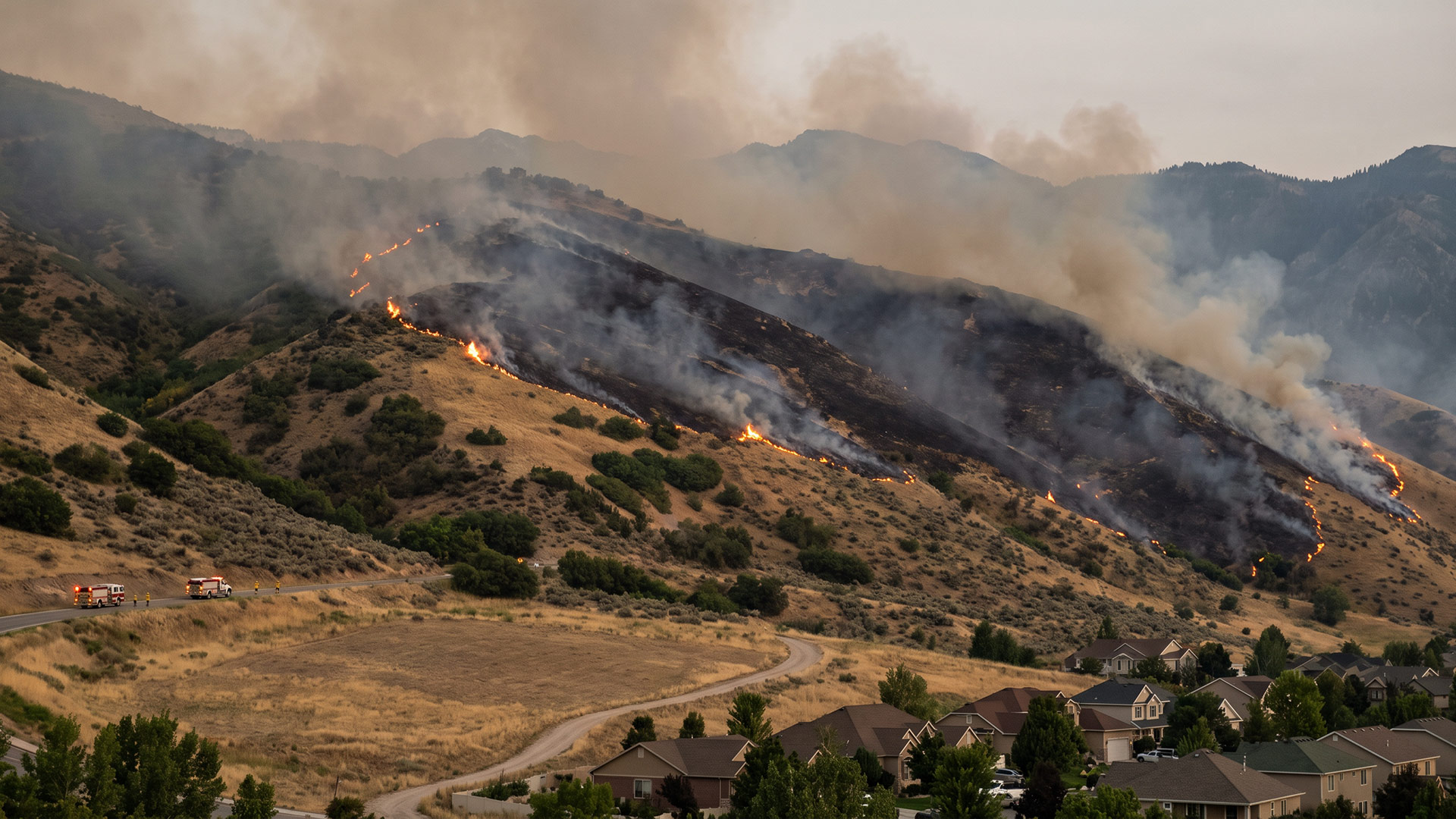
At NOMAD, we increasingly think about wildland and forestry fire as a geography problem.
The historical map of wildfire risk is becoming less useful as a predictor of the future.
Large-scale ocean-atmosphere phenomena such as ENSO and other recurring climate cycles influence temperature, rainfall, drought, snowpack, vegetation growth and subsequent fuel availability across enormous geographic areas. Their effects interact with longer-term changes in seasonal temperatures, land management, vegetation, water availability and expanding wildland-urban interfaces.
The important consequence for the fire service is not simply that historically fire-prone places may experience larger fires.
It is that serious wildland fire capability is becoming relevant in places where history gave communities little reason to build it.
Fire seasons change.
Their duration changes.
Vegetation changes more slowly.
Equipment fleets and procurement cycles change slower still.
We believe this changing geography will make wildland, forestry and rural firefighting one of the most rapidly evolving categories in the global fire industry over the coming decades.
NOMAD exists to help engineer for that new fire geography.
Follow the risk before the revenue
That belief will increasingly influence how we run the company.
We intend to look beyond yesterday’s pump sales and yesterday’s political market boundaries.
Over time, macro climate indicators, satellite observations, vegetation conditions, drought data, fire history and other geographic information should help influence where we develop dealer capability, where we position inventory, what products we prioritize and what applications our engineers should be solving next.
The question isn’t only:Where are wildland pumps sold today?
It’s:Where will firefighting water-movement capability be needed tomorrow?
That distinction matters.
A region with little historical demand may become strategically important before its procurement system recognizes the change. A product optimized around North American wildland practices may not be the right product for Australia, the Mediterranean, the Alps or emerging fire environments farther north in Europe.
Our ambition is to understand those differences – and build accordingly.
Pumps are the specialization
NOMAD isn’t intended to become an everything-for-forestry company.
There are already good companies doing that.
Our specialization is deliberate:
We engineer pumps, pump controls and firefighting water-movement systems.
From lightweight portable pumps to high-pressure systems, diesel modules, electric pumping and ultimately large-flow vehicle-mounted platforms, we intend to develop the category deeply rather than surround it with every possible adjacent SKU.
That philosophy should sound familiar to anyone who knows RAMFAN.
RAMFAN became successful by concentrating on moving air.
NOMAD intends to bring that same specialist mentality to moving water.
Petrol. Diesel. Electric. Whatever solves the problem best.
We also don’t believe the future of pumping is simply replacing every combustion engine with a battery.
Electric drive can provide remarkable advantages: instant torque, precise speed and pressure control, lower noise and vibration, reduced routine maintenance and entirely new possibilities for vehicle integration.
But those advantages matter only when the complete system works in the environment where firefighters actually operate.
Australian bushfire conditions can exceed 55°C ambient temperature, with direct sunlight, dust and sustained high-load operation. That’s why, for example, our 10 kW P5e architecture uses liquid cooling for its electric drive and energy system rather than assuming an electric motor is automatically the better solution simply because it is electric.
Where a Honda petrol engine is the right answer, we’ll use one.
Where Kubota or Yanmar diesel power makes sense, we’ll use it.
And where electric drive materially improves the mission, Euramco brings something relatively unusual to the pump industry: decades of internal experience developing motors, motor controllers, rugged lithium battery systems, power electronics and connected controls.
That capability gives NOMAD room to explore where firefighting pumping goes next rather than simply reproducing where it has already been.
Three new pumps in Melbourne
AFAC 2026 represents the next step.
The NOMAD P1 is our lightweight, straightforward portable platform for applications where simplicity, portability and field serviceability matter.
The NOMAD P5d moves into diesel-powered truck and skid applications for bushfire appliances, auxiliary pumping and larger mobile water systems.
And the NOMAD P5e begins to show another side of the roadmap: a 10 kW electric pump architecture intended for vehicle integration, combining hydraulic engineering with the electric-drive capabilities Euramco has accumulated elsewhere in the group.
These aren’t intended to represent the limits of NOMAD.
They’re the beginning.
Additional P-series platforms are already under development as we build toward a much broader family of firefighting pumps.
For now, however, the commercial debut of these products is deliberately focused on Australia and New Zealand, together with our long-standing regional partner, Fire Rescue Safety Australia.
There will be plenty more to say about the rest of the world later.
And about that logo…
If the NOMAD logo looks slightly different from the usual fire-equipment corporate identity, that’s intentional too.
I designed it with a little inspiration from the Parental Advisory stickers plastered across punk, alternative and hip-hop CDs when I was growing up in the 1990s.
Partly because I liked the graphic.
Partly because NOMAD should have a little attitude.
And partly as a small design-level protest against where a lot of industrial manufacturing has gone.
Euramco remains a family-owned manufacturing company, now in its third generation of leadership.
The fire industry, meanwhile, has experienced decades of consolidation. Many historic manufacturers and brands now sit inside increasingly large corporate and private-equity-owned groups.
There is nothing inherently wrong with scale or institutional ownership.
But we’re comfortable choosing another path.
We like engineers arguing about a casting.
We like people worrying about whether a seal will survive ten years from now.
We like having inventory available when a customer actually needs it.
We like developing products because we believe they should exist.
And we hope – although you never really know – that nobody around our table someday decides reducing production capacity and inventory would make the next quarterly report look a little nicer.
The logo is our small reminder of that.
Independent. Specialized. Slightly stubborn.
That’s probably a reasonable description of NOMAD too.
Back to water
More than half a century separates those early naval pumps in San Diego from the three NOMAD products arriving at AFAC in Melbourne.
Between them came naval damage-control equipment, RAMFAN, hazardous-area ventilation, brushless motors, batteries, power electronics, Kraken Power and PRO//connect.
That journey gave us capabilities the company that originally built pumps in the 1960s couldn’t possibly have imagined.
Now we’re bringing them back to water.
Not because the fire industry needs another pump brand.
Because we believe the geography of fire is changing, the technology available to firefighters is changing with it, and there is room for a specialist manufacturer willing to think about what firefighting water movement should look like for the next several decades.